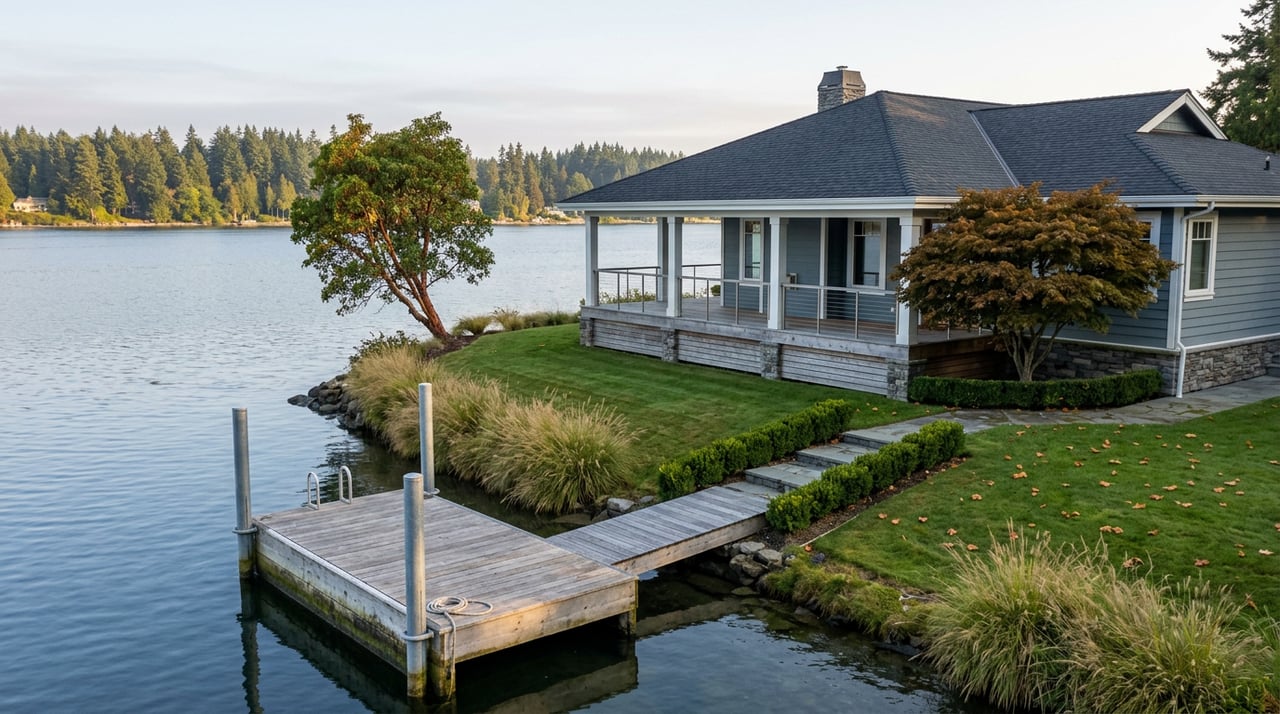
The Ancich Dock has jutted 270 feet into Gig Harbor Bay from the Millville neighborhood for more than a century. It has survived storms, ownership changes, and decades of use by the local fishing fleet. What it hasn't survived is a lease renewal. The Washington Department of Natural Resources, which owns the tidelands beneath the structure, made removing or replacing the dock a condition of renewing the tidelands lease. Creosote-treated piles, an aging deck, and a footprint the state now considers too large for a modern harbor added up to one outcome: rebuild it to current standards or lose it entirely.
The owners chose to rebuild, with steel piles, better light penetration for the water below, and a smaller overwater footprint. That plan cleared the City of Gig Harbor's hearing examiner, then was appealed by a neighboring property owner to the Washington State Shorelines Hearings Board in early 2025. Even a well-designed replacement dock, backed by an approved city permit, still had to survive a state-level challenge before construction could begin.
That fight is happening in the harbor's easy water, a protected, already-developed stretch where new moorage has never been controversial. If a century-old dock in the most permissive part of Gig Harbor's shoreline can get tangled in a multi-year lease and permitting dispute, it's worth asking what's waiting for a buyer who assumes any "waterfront" listing on the peninsula comes with the same rights.
It doesn't. And the split isn't new construction versus old. It's geography.
The Rule Most Owners Didn't Notice Take Effect
In December 2022, the Pierce County Council passed updates to the county's Shoreline Master Program restricting new residential pier and dock construction along an additional stretch of saltwater shoreline based on habitat and ecological criteria identified by outside consultants. The county formally adopted Ordinance 2023-75, the Washington State Department of Ecology approved it on March 5, 2024, and it became binding law on March 18, 2024.
The practical effect: new residential piers and docks are now prohibited along roughly 49.2 additional miles of Pierce County's saltwater shoreline. That's stacked on top of 75.8 miles that were already off-limits for ecological or commercial reasons, much of it bordering the Gig Harbor and Key Peninsulas and Fox Island. Put those numbers together and a meaningful share of the local coastline is now permanently closed to new moorage, regardless of what a future owner wants to build.
This isn't a rule buried in a code section nobody reads. It changes what a specific parcel is actually worth to a boater, and it's been the law for over two years, quietly reshaping which "waterfront" listings can deliver on the lifestyle the photos imply.
Henderson Bay Loses. Wollochet Bay Doesn't.
The new restrictions aren't spread evenly across the peninsula, and that unevenness is the part worth understanding before you fall for a listing photo.
Much of Henderson Bay, along with the west sides of Fox Island and Key Peninsula, is now off-limits to new residential docks and piers under the 2024 rule. These are stretches where the shoreline retains intact ecological function, relatively few existing overwater structures, and features like wide tidal flats and unstable slopes that made them priority targets for protection.
Wollochet Bay and Horsehead Bay landed on the other side of the line entirely. Both already have a high density of existing docks, and county officials reasoned that adding more moorage in water that's already developed doesn't create the same ecological cost as building new structures along a relatively undisturbed shoreline. New docks remain allowed there.
That logic makes sense from a habitat standpoint. It also means two waterfront parcels that look identical in a listing, similar footage, similar bank height, similar price range, can carry completely different long-term utility depending on which side of an invisible line they sit on. A property on Wollochet Bay can still add a dock if it doesn't already have one. A comparable property on the newly restricted stretch of Henderson Bay generally cannot, no matter how much the buyer is prepared to spend on permitting.
Deeded Tidelands Don't Settle the Question
Here's where it gets easy to misread a listing. Waterfront properties on the peninsula are frequently marketed with language about tideland rights, private beach access, or mooring buoys, and buyers reasonably assume that language answers the dock question. It doesn't.
Tideland ownership and shoreline development permitting are two separate legal layers. Owning the tidelands in front of your property, whether through a historical state patent or a recorded deed, tells you who holds the submerged land. It doesn't tell you whether the county or city will approve a new pier or dock on it. A parcel can have privately deeded tidelands and still sit inside one of the newly restricted shoreline segments, in which case the tideland ownership becomes largely academic for anyone hoping to build new moorage.
The reverse is also true. If a dock or float would extend over state-owned aquatic land rather than private tidelands, the Washington Department of Natural Resources typically requires a separate lease or authorization before construction, on top of whatever local shoreline permit applies. Two layers of government, two separate approvals, and neither one automatically follows from the other.
Existing Docks Aren't Permanently Safe Either
The Ancich Dock situation is the clearest local proof that even a legal, decades-old dock isn't guaranteed forever. Because DNR owns the tidelands underneath it, the dock's continued existence has always been tied to lease terms the state controls, and this renewal cycle came with conditions the previous structure couldn't meet.
The city's own shoreline activity nearby reinforces how active this oversight remains right now. In June 2026, Gig Harbor's hearing examiner approved a shoreline permit for the city's long-planned Commercial Fishing Homeport at Ancich Waterfront Park, a project the city has pursued since buying the site in 2012. The hearing examiner called it one of the more straightforward shoreline permits he'd reviewed, but even a straightforward approval still required coordination with NOAA and other federal reviewers, plus mitigation credit purchases to offset the project's environmental impact. This is a city-led project with institutional resources behind it, and it still took over a decade to reach approval.
For a private owner, the lesson isn't that every dock is at risk. It's that a dock's paperwork, specifically the lease term, renewal conditions, and permit history, matters as much as its physical condition when you're deciding what a property is actually worth to you.
Before You Write an Offer on Anything With a Dock
A few steps before removing contingencies can save months of surprise later:
Confirm tideland ownership. Ask the title company whether the property's tidelands are state-owned or privately conveyed, and get that answer in writing before you rely on any dock-related listing language.
Request the DNR lease if one exists. If any structure crosses state-owned aquatic land, ask for the current lease, its expiration date, and any conditions attached to renewal. This is the paperwork that determines whether an existing dock survives its next renewal cycle.
Check which shoreline segment the parcel sits in. Before assuming you can add or expand moorage, contact the Pierce County Planning and Public Works Department for unincorporated areas or the City of Gig Harbor Planning Division for parcels inside city limits, and ask directly whether new pier or dock construction is currently permitted for that specific stretch of shoreline.
Get the permits, not just the photo. A dock in a listing photo tells you it exists. It doesn't tell you it's permitted. Ask for the shoreline permit, as-built drawings, and any DNR authorization tied to the structure.
Never assume future rights on vacant waterfront land. If you're buying an unimproved lot with the intention of building a dock down the road, confirm that right in writing during due diligence rather than after closing.
A Few Questions Worth Asking Before You Get Attached to a Dock
Does the 2024 rule affect repairs to an existing dock, or only new construction? The restriction targets new pier and dock construction. Repairs and maintenance to a legally permitted existing structure are handled under a different set of rules, though major reconstruction, like the Ancich Dock's full rebuild, can trigger the same permitting process as new construction.
Does this apply to freshwater lakes on the peninsula as well as saltwater shoreline? The 2024 ordinance specifically addresses saltwater shoreline. If you're evaluating a lake property, confirm the applicable rules separately with county planning staff rather than assuming the saltwater restrictions carry over.
Who do I actually call, the city or the county? It depends on the parcel. Properties inside Gig Harbor city limits fall under the City of Gig Harbor Planning Division. Properties in unincorporated Pierce County, which includes most of the outer peninsula and Key Peninsula, fall under Pierce County Planning and Public Works.
Waterfront ownership on the peninsula has always required more homework than a typical residential purchase, and the 2024 shoreline changes added a layer that a lot of buyers won't discover until they're already past their inspection window. Whether you're weighing a purchase, preparing to sell a waterfront rental, or trying to understand what your current dock's lease terms actually allow, it helps to have someone local walk through the paperwork before it becomes a closing-day surprise. Gig Harbor Property Management works with owners across the peninsula every day on exactly this kind of due diligence, and through Christopher Threet's connection to Greater Peninsula Properties, that same local knowledge extends to buying and selling waterfront homes, not just managing them. If a dock, a lease, or a shoreline designation is part of your next decision, reach out before you write the offer.